The Unseen Millions: The Roma of the Balkans
"You will receive power when the Holy Spirit has come upon you, and you will be my witnesses in Jerusalem and in all Judea and Samaria, and to the end of the earth." — Acts 1:8
This week, Europe is watching the Balkans. Regional leaders are in New York for the UN General Assembly, and next week European Commission President Ursula von der Leyen begins her annual Western Balkans tour — Tirana, Pristina, Podgorica, Skopje — with Belgrade and Sarajevo skipped ahead of Bosnia's October 4 general elections and Serbia's October 25 parliamentary vote. The headlines are about enlargement, elections, and stability. None of them mention the ten to twelve million Roma who live in the middle of all of it.
That is the question Operation 326 keeps asking: who are we not seeing? The frontier is not only far away — sometimes it is the people the whole continent's cameras pan straight past.
A name on a list is a life before God
Meet Mirela — a Roma listener in Serbia whose story was reported this month by Evangelical Focus, from the ministry records of TWR. Her childhood was hard: a sick mother, a stepfather who shouted and beat her nearly every day, hunger, dirt, school attended only when no one insisted. "Nobody paid attention to me," she said. "I didn't feel loved or accepted."
Then a friend told her about Jesus. She went to church and began listening to TWR programs in the Romani language — broadcasts she had not known existed. They gave her, she said, the motivation to return to school, finish her education, find a good job, and marry a Christian husband. "That is why I want other young people to understand," Mirela said, "that Christ is the one who changes lives and lifts people up from the mud."
Mirela is one person. But her story is a window into millions. The Roma — once called "Gypsies," a term many now consider disparaging — are one of the largest minority groups on the continent: some ten to twelve million people, descended from a migration out of northern India more than a thousand years ago. They have no homeland of their own, and they remain, in TWR's words, a people "overlooked for too long" — centuries of marginalization, millions in poverty, children in segregated schools. That is the reported picture from Amnesty International and the missionaries among them. It is not a statistic. It is the world Mirela grew up in.
The language of home
Here is what makes this a frontier story, not merely a compassion story: the language itself has been the locked door. Romani, as spoken across Europe, carries only a simplified core vocabulary — roughly a third of daily speech — with the rest borrowed from each host country. A people scattered across a dozen nations, divided by the languages of their neighbors, with limited access to biblical teaching in their own tongue.
The most encouraging news in this month's reporting is quiet and specific: the door is beginning to open in the language of the heart.
In Albania, TWR's Women of Hope programs reach Roma women in Romani; one listener, Sanije, said simply, "I didn't know that a program in our language even existed. It was so good when I listened to it in my language."
In North Macedonia, Pastor Edijan — himself Roma — carries the Gospel to his own people through Voice of Truth online. "When Roma people hear the gospel in our language, something changes," he says. "They know they are not forgotten. They know they matter."
In Serbia, the number of Roma believers is reported as steadily growing, and new biblical resources are appearing in Serbo-Romani itself: Šalom Romalen (Roma Peace) and Romano Krlo, produced by Pastor Šerif and a Roma ministry team serving within their own community.
In Romania, Thru the Bible and Love Worth Finding now air in Romani Kalderash, and a Roma Discipleship Tool video podcast — scripts written by Roma pastors — feeds new online Bible-study groups.
These are beginnings. They must be named as beginnings, not as completion. A broadcast existing is not the same as a witness existing; a witness existing is not the same as a disciple-making church existing. Operation 326's discipline exists precisely to keep those distinctions honest.
Identity controls: "the Roma" is not one people
Here the researcher's caution matters as much as the pastor's hope. "Roma" is not a single people group — it is a cluster of communities with different histories, religions, and languages, and the frontier looks different in each. In Prilep, North Macedonia, roughly 15,000 marginalized Roma are described by TWR as 98% from a Muslim background — a distinct Gospel-access reality from nominally Christian Roma contexts a few valleys away. (TWR-reported, not independently field-verified: a flag for evidence work, not a conclusion.) This is why Operation 326 keeps separate country records and refuses to let evidence from one shore be assumed on another. A single status label for "the Roma" would hide the very communities still waiting.
The ends of the earth, in Europe
Acts 1:8 holds Jerusalem, Judea, Samaria, and the ends of the earth together — the near and the far in one sentence. The Church has often read "the ends of the earth" as "far away." But the ends of the earth are wherever people still wait for a first clear chance to hear — and some of those places sit in the shadow of Europe's cathedrals, a short drive from the capitals the cameras are covering this week.
Every person has a birthright to hear the Gospel at least once. That conviction does not stop at a continent's edge. It includes the Roma grandmother outside Skopje, the Muslim-background teenager in Prilep, the migrant Roma family newly arrived in a Western European city — each one a person before God, each one owed a clear opportunity to hear in the language of home.
From information to participation
When research identifies a gap, our first response should not be fascination. It should be prayer — and then participation.
Pray: for the Muslim-background Roma communities of the Balkans, that heart-language witness would take root in local churches. For workers like Pastor Edijan in North Macedonia and Pastor Šerif's team in Serbia — Roma believers reaching Roma communities. For the new Serbo-Romani resources, that they would move from programs to disciples to churches. And for wisdom for the researchers: which communities are still unseen?
Send and go: heart-language ministry needs people willing to learn Romani dialects and love Roma communities for the long road — translators, media workers, church planters, and the churches behind them.
Adopt and give: a church can adopt a Roma community in prayer — Prilep is one name among many — and give toward translation, radio, and discipleship tools in Romani languages.
Engage: the frontier is not only far away. Roma families live in cities across Europe. The neighbor the headlines miss may be on your street — notice them, welcome them.
Mirela's story ends with a sentence worth carrying into this week: "Christ is the one who changes lives and lifts people up from the mud." Ten to twelve million people. Overlooked for too long. Not by God.
One Mission. One Movement. One Chance.
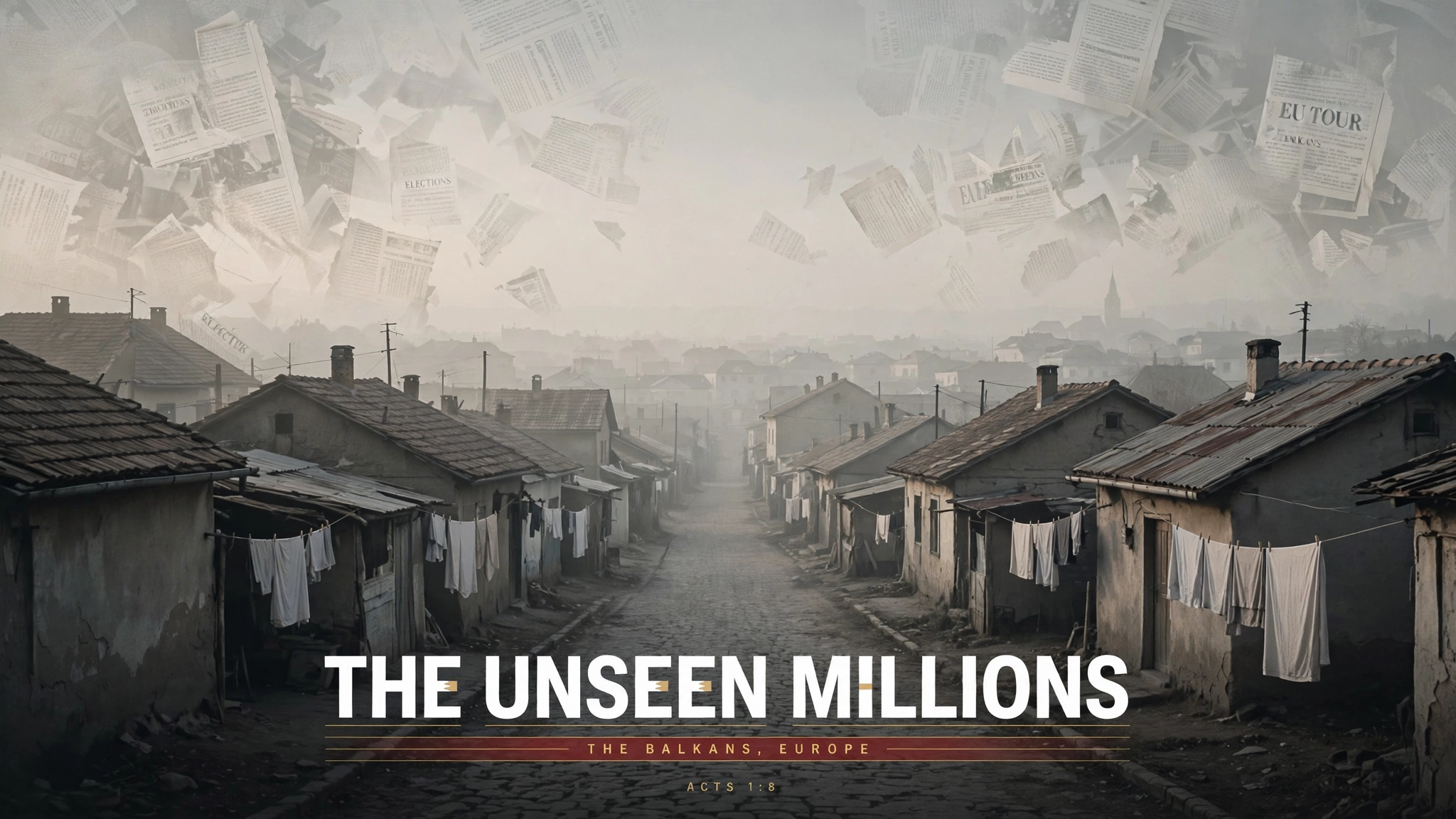
Research sources: Evangelical Focus, "Transforming Roma lives: How Christian missions is reaching the unreached in the Balkan region" (TWR reporting, ~Sept 24, 2026); Amnesty International via same; OCFEP Operation 326 public research dashboard (ocfep.com/operation-326/research/) — no Roma records currently listed; Joshua Project Roma cluster profiles consulted for identity-control context only (subgroup statuses vary by country; no single status cited). Featured image: branded Operation 326 editorial illustration in Headline mode, inspired by this week's Balkans news cycle. It is contextual artwork and does not depict the Roma community, an exact location, or ministry activity.
Leave a Reply