Weekly Operation 326 research update — verified 21 August 2026
Jesus’ words in Acts 1:8 give the Church both a promise and a geography: “You will receive power when the Holy Spirit has come upon you, and you will be my witnesses in Jerusalem and in all Judea and Samaria, and to the end of the earth.” Operation 326 exists because the final phrase still carries a measurable responsibility. Every people deserves a clear witness, and every research record must help us see where that witness is present, where it is uncertain, and where it may still be absent.
This week’s intelligence review brought one especially useful case into focus. It is not a new status change in the public Operation 326 list. It is an external audit case that strengthens the identity controls behind the research: the Idu people, recorded by Joshua Project under PeopleID3 13050 and the Idu-Mishmi language under ISO 639-3 code clk, appear in two country-specific records with very different ministry realities.
The verified finding
Verified fact: Joshua Project’s current country profiles identify an estimated 10,000 Idu Lhoba in China and 8,600 Idu in India. Both profiles use PeopleID3 13050 and the same primary-language code, clk. Both also report Scripture portions dating to 2000, an Idu-Mishmi New Testament dated 2024, and audio Bible teaching.
But the country records do not have the same status. The China subgroup is marked Unreached: Yes and Frontier: Yes, with an estimated 0.0 percent Christian population. The India subgroup is marked Unreached: No and Frontier: No; its profile reports a 10.3 percent Christian census estimate while warning that current values may differ. The two records share an ethnolinguistic identity, but the border changes the available evidence about access, witness, and church presence.
That distinction is precisely why Operation 326 treats a people record as more than a name. The working identity lock is:
PeopleID + ISO language + country-specific subgroup.
If any one of those elements is ignored, research can create false confidence. A New Testament in a language does not prove that every country subgroup can obtain it. A known church among one subgroup does not establish a reproducible church presence among another. And a shared ethnonym does not erase political boundaries, mobility restrictions, social networks, or the practical distance between a resource and the families who need it.
What the data does—and does not—tell us
The verified data tells us that an important language resource exists. That is genuinely good news. Translation is one of the great enabling works of Acts 1:8 because it gives the witness a form that can be heard and understood in the heart language.
Yet resource existence is not the same as resource access. The current profiles do not demonstrate how widely the 2024 New Testament is distributed in each country, how many households can use it, or whether trusted local believers are present to explain it. They also do not establish a pathway by which the stronger reported Christian presence in India reaches the China subgroup.
Research inference: the Idu case suggests that the remaining gap may be less about whether Scripture has been translated and more about whether people can safely encounter the message, understand it, respond to it, and gather in a locally rooted fellowship. This is an inference to test—not a fact to declare.
For that reason, Operation 326’s completion logic must keep four questions separate:
- Identity: Are we looking at the right people, language, and country subgroup?
- Access: Can ordinary people actually receive or hear the available gospel resources?
- Witness: Is there a credible, understandable, relational presentation of Jesus?
- Church: Is there a sustainable local body capable of carrying the witness forward?
A “yes” at one stage cannot be copied into the next stage without evidence.
Closer to the end of the earth
Acts 1:8 does not describe a Church that merely possesses a message. It describes a Spirit-empowered people who carry that message outward. The movement from Jerusalem to Judea, Samaria, and the end of the earth crosses familiar boundaries, difficult boundaries, and finally the boundaries we might prefer not to see.
The Idu records remind us that “the end of the earth” can exist just across a border from a community with the same language. On a global map, the distance may look small. In human terms, it can be enormous.
This is where careful research becomes an act of love. Precision protects people from being counted as reached because of evidence that belongs to someone else. It also protects ministry partners from acting on an attractive but untested assumption. We do not need inflated certainty. We need enough verified clarity to pray intelligently, cooperate wisely, and move only through appropriate, lawful, locally informed channels.
This week’s next research step
No Operation 326 status is being changed on the basis of this comparison alone. The next responsible step is a resource-access audit: confirm the 2024 New Testament’s formats and distribution channels, seek corroboration for present church reality in each country subgroup, and record confidence separately for identity, access, witness, and church evidence. Public reporting should remain aggregated and must not expose names, routes, meeting places, or other sensitive field details.
Completion comes closer when our records become more truthful and our obedience becomes more focused. The promise of Acts 1:8 is not that the task will be completed by better spreadsheets. It is that the Holy Spirit will empower witnesses. But good research can help those witnesses see the remaining gaps clearly—and refuse to confuse a resource on a list with a person who has truly had the opportunity to hear.
Every people. Every country context. A clear witness at least once.
Sources: OCFEP Operation 326 Research (primary project framework and current public inventory); Joshua Project — Lhoba, Idu in China; Joshua Project — Idu in India. Figures are source estimates and should be treated as research indicators rather than censuses of present spiritual reality.
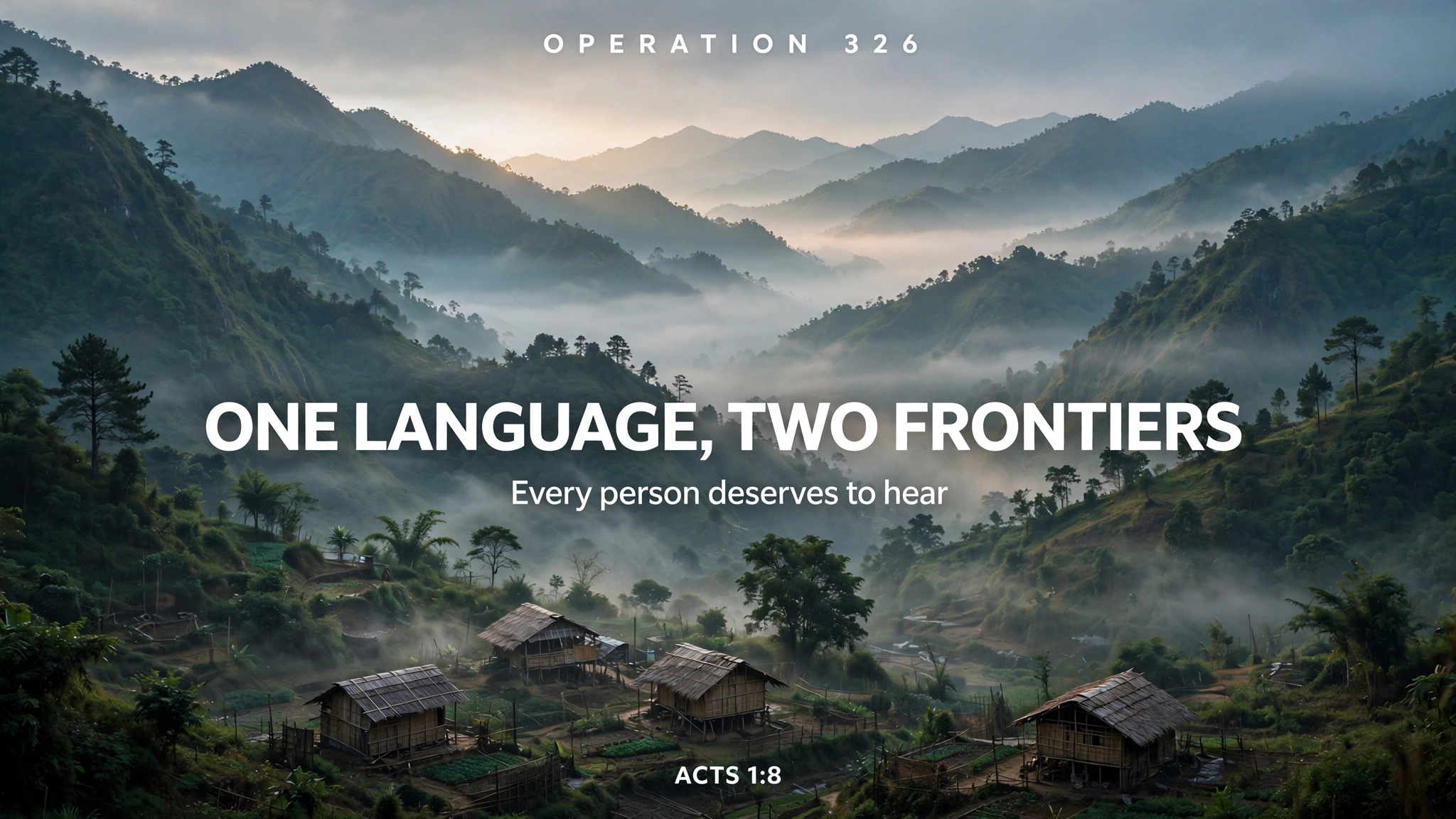
Featured image: Idu Mishmi village, Upper Dibang Valley District, Arunachal Pradesh, India (1987). Photo by goldentakin, licensed CC BY 2.0, via Wikimedia Commons. The image is contextual and is not used to infer the current status of any person or congregation.